
How to Inspect an Office Workstation Factory in Bangalore Before You Place an Order
Brochures and quotations all look good. A factory floor does not lie. If you are shortlisting office workstation manufacturers in Bangalore, a one-hour visit can tell you more than ten emails.
This guide gives you a practical checklist. You will know what to look at, what to ask and which warning signs to take seriously.
Quick Answer: What Should You Check on a Factory Visit?
When you visit an office workstation manufacturer, check these six things:
- Ownership: Is production truly in-house, or outsourced?
- Machinery: Are panels cut, edge-banded and drilled by modern machines?
- Materials: Are board grades, laminates and hardware clearly labelled?
- Finishing: Are edges sealed, joints tight and surfaces uniform?
- Quality control: Is there a defined inspection step before dispatch?
- Support: Are installation, warranty and after-sales terms written down?
The rest of this article explains each point in detail.
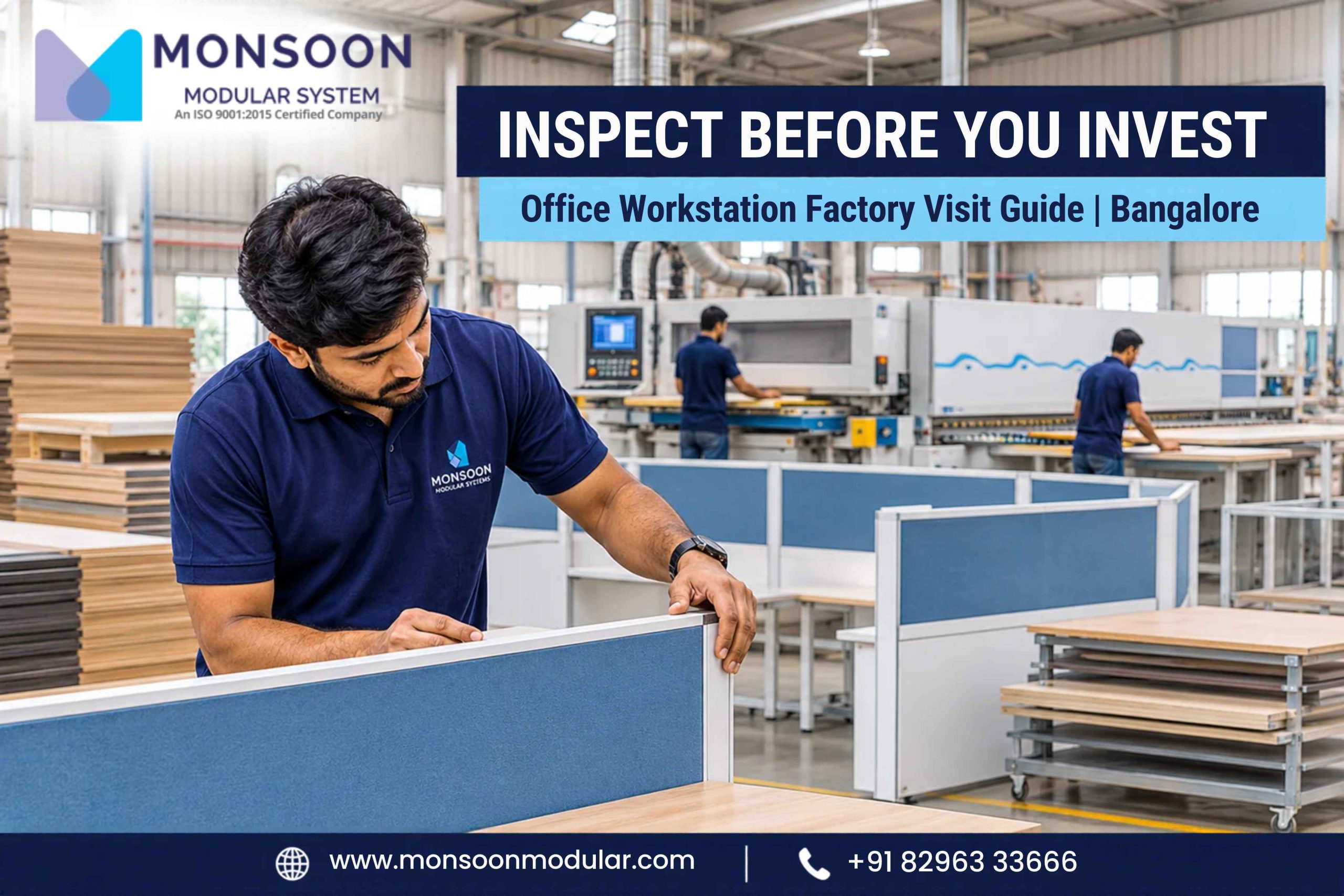
Book a factory visit with Monsoon Modular Systems
Why a Factory Visit Matters Before You Buy
A workstation is a daily-use asset. Dozens of people will sit at it for years. Weak edges peel, thin panels sag, and poor hardware loosens.
A visit also separates manufacturers from traders. A trader may quote a low price, but cannot control sizing, finish or delivery dates. A manufacturer who owns the process can. That control matters most for custom layouts, bulk orders and tight fit-out deadlines.
Before You Go: Prepare These Basics
Walk in with clear inputs. You will get sharper answers and a more useful visit.
- Headcount and seating plan: Total seats, team sizes and growth plans.
- Floor plan: Even a rough sketch with dimensions helps.
- Workstation format: Linear, L-shape, cluster or cubicle.
- Storage needs: Pedestals, overhead units or separate cabinets.
- Timeline and budget range: So the manufacturer can plan realistically.
If you are unsure about formats, review the office workstation range first. You will then know which products to ask to see in person.
What to Check Inside the Factory
1. Is Manufacturing Really In-House?
Ask a direct question: “Which of these processes happen in this building?” Cutting, edge banding, drilling, pressing, and assembly should be on the list.
In-house production gives you tighter control over dimensions, finish and lead time. It also makes customisation easier because changes don’t wait on a third-party vendor.
For reference, Monsoon Modular runs its own unit in Singasandra, Bengaluru. You can see its machinery on the infrastructure page before you visit.
2. Machinery and Production Setup
Good machines produce repeatable results. Look for:
- Beam saw or panel cutting machine: Delivers accurate, clean panel sizes.
- CNC router: Handles cut-outs, cable ports and detailed profiles precisely.
- Edge banding machine (ideally CNC): Applies even, tightly bonded edging.
- Boring or multi-head drilling machine: Aligns hinge and fitting holes accurately.
- Pressing machine: Bonds laminates and surfaces evenly.
Also watch the floor itself. Are machines maintained? Are offcuts managed? Is there a clear flow from raw panel to finished part? An organised floor usually means organised output.
3. Raw Materials and Board Quality
Ask to see the boards, not just samples. Check:
- Board type: Particleboard, pre-laminated MDF, or plywood. Each suits different uses.
- Thickness: Worktops and partitions should match the thickness quoted.
- Grade and emission rating: Ask whether boards are low-emission, such as E1 class.
- Storage condition: Boards stored flat, dry and off the ground resist warping.
- Labels and batch records: Branded, traceable stock is a good sign.
Moisture is the silent enemy in Bangalore’s monsoon months. Wet or poorly stacked boards swell at the edges, and that damage never reverses.
4. Laminates, Hardware and Accessories
Details decide longevity. Ask which brands of laminates, hinges, drawer channels and locks go into your order. Then test them.
- Open and close a drawer ten times. It should glide without wobble.
- Press a locker door. It should align and latch without force.
- Check metal frames for even coating and no rust spots.
5. Edge Finish, Joints and Surface Quality
Run your finger along every edge. It should be smooth, sealed and free of gaps. Peeling edges are the most common complaint on cheap workstations.
Then inspect:
- Joint lines between panels. They should be tight and straight.
- Laminate surfaces. Look for bubbles, scratches and colour variation.
- Screw and cam-lock points. They should sit flush and feel firm.
6. Quality Control Process
Ask: “Who inspects the product, and when?” A credible manufacturer can describe its checkpoints. These usually include incoming material checks, in-process dimension checks and a final inspection before packing.
Production overseen by trained engineers is a strong sign. Ask to see a finished unit that has already passed inspection.
7. Customisation Ability
Few offices fit a standard catalogue. Ask whether the manufacturer can adjust sizes, partition heights, colours, cable management and storage. Then ask for an example of a custom job they have delivered.
If your needs go beyond furniture, check whether they also handle turnkey office interiors. One team for furniture and fit-out reduces coordination headaches.
Questions to Ask the Factory Team
Take this list with you. Strong manufacturers answer clearly and without hesitation.
- What is your typical lead time for an order of my size?
- Can you provide a 3D layout or drawing before production starts?
- Which materials and brands will go into my specific order?
- Who handles delivery and installation, and is it included in the quote?
- What warranty do you offer, and what does it cover?
- Can I speak with a client who has a similar-sized office?
Check the Product Range and Track Record
A manufacturer with a wide range can supply your whole office from one source. Beyond workstations, you may need storage furniture, manager tables and conference tables.
Matching finishes across all of these keeps the office looking cohesive. It also simplifies billing and warranty.
Next, review the client list to see the kinds of businesses they serve. Ask for references you can call.
Plan your workstation project with our Bangalore team
Red Flags to Watch For
Walk away, or at least push harder, if you notice any of these:
- Vague answers about who makes what. This often signals outsourcing.
- No finished samples to touch. Renders alone prove nothing.
- Unlabelled or mixed-up board stock. Traceability is missing.
- A messy floor and idle, poorly maintained machines. Output will reflect it.
- Reluctance to put warranty and installation terms in writing.
- A price far below every other quote. Something is being cut, usually material quality.
How to Compare Two Manufacturers Fairly
Use the same yardstick for each factory you visit. A simple scorecard works well. Rate each item from 1 to 5:
Criteria | What to look for |
In-house capability | Cutting, edging, drilling and pressing on site |
Material quality | Labelled boards, good storage, clear grades |
Finish | Sealed edges, tight joints, even surfaces |
Hardware | Smooth drawers, firm locks, rust-free frames |
Quality control | Defined checkpoints and final inspection |
Customisation | Real examples of tailored layouts |
Support | Written installation and warranty terms |
Score right after each visit, while details are fresh. Compare totals, and also look at which weaknesses matter most to your office.
Pricing deserves a fair comparison too. Our office table buying checklist explains how to compare quotations on a like-for-like basis. If you also plan to store files or stock, read slotted angle racks vs heavy-duty racks before finalising storage.
After the Visit: Next Steps
- Request a written quotation that lists materials, sizes, quantities and finishes.
- Ask for a layout drawing or 3D render based on your floor plan.
- Confirm the timeline for production, delivery and installation.
- Get warranty and after-sales terms in writing.
- Visit a live project if possible, to see how the furniture holds up in use.
Final Thoughts
A factory visit takes an hour or two, but it protects a purchase that will serve your team for years. Look at the machines, touch the finish, question the process and compare manufacturers using the same checklist.
If you are in Bangalore, you can see a working production setup at Chikkabegur Industrial Estate, Singasandra. The team is available Monday to Saturday, 9:30 AM to 6:00 PM.
Talk to Monsoon Modular Systems about your office workstations