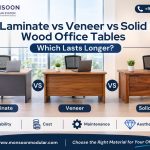
Which Office Table Material Lasts Longest? Laminate, Veneer and Solid Wood Compared
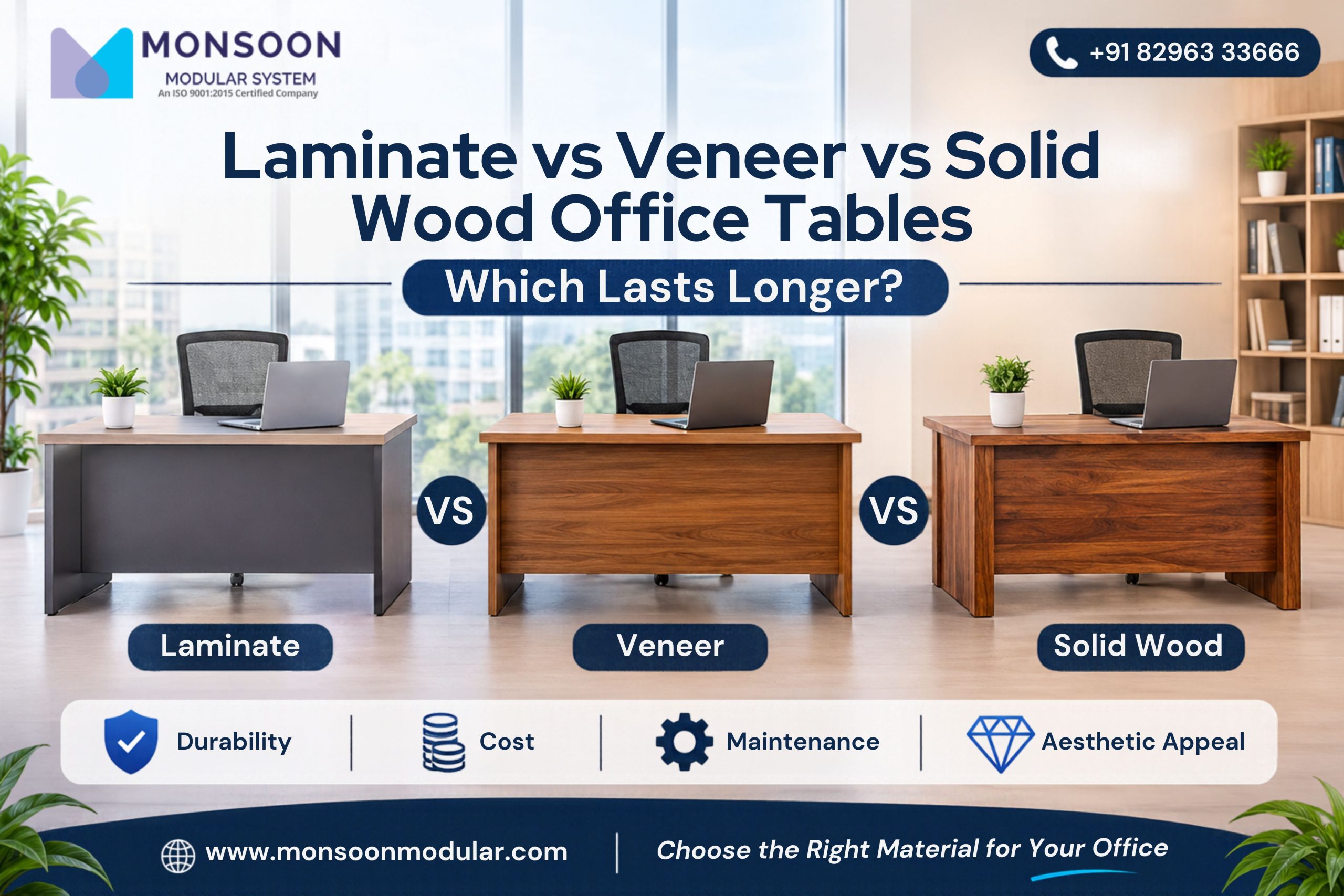
Quick answer: Solid wood usually lasts longest, often 20 years or more with care. Laminate is the most practical for busy offices and typically lasts 8 to 15 years. Veneer sits in the middle at roughly 10 to 20 years. The right choice depends on your budget, how heavily you use the table, and your climate. These ranges are general industry experience, not guarantees, and results vary with build quality and care.
Choosing an office table is a long-term decision. A table that chips, swells or peels in three years costs far more than one that looks good for fifteen. This guide compares laminate, veneer and solid wood on durability, cost, maintenance and look, so you can choose with confidence.
Talk to our furniture experts for a quick recommendation for your office. Read on to see how each material really performs.
What Are the Three Office Table Materials?
Before comparing, it helps to know what each material actually is.
Laminate
Laminate is a decorative surface made by pressing layers of paper and resin under heat and pressure. It is bonded to a core board such as particleboard, MDF, or plywood. The printed top layer can imitate wood, stone or solid colours.
Veneer
Veneer is a thin slice of real timber, usually less than 1 mm thick, glued onto a core board. It gives you the genuine grain and warmth of wood at a lower cost and weight than a full timber slab.
Solid Wood
Solid wood tables are built from timber boards throughout, such as teak, sheesham, oak or rubberwood. There is no thin surface layer, so the material you see is the material all the way through.
Laminate vs Veneer vs Solid Wood: Side-by-Side Comparison
Factor | Laminate | Veneer | Solid Wood |
Typical lifespan | 8 to 15 years | 10 to 20 years | 20+ years |
Scratch resistance | High | Low to medium | Medium |
Water and stain resistance | High | Low to medium | Medium |
Humidity tolerance | Good with quality edge banding | Moderate | Can swell or warp if untreated |
Repairability | Hard to repair | Can be re-polished or patched | Easy to sand and refinish |
Upfront cost | Lowest | Medium | Highest |
Look and feel | Uniform, modern | Natural grain | Premium, authentic |
Maintenance | Very low | Moderate | Moderate to high |
Which Office Table Material Is Most Durable?
Durability is not one thing. A table can resist scratches yet fail at the edges, or survive decades yet show every coffee ring. Here is how each material holds up.
Laminate Office Tables: Tough Surface, Weak Edges
Laminate has the best day-to-day resistance. It handles scratches, spills, heat from cups and constant laptop use better than veneer. That is why it dominates workstations and shared desks.
Its weak point is the edge. If the edge banding is thin or poorly glued, moisture enters the core board, and the surface starts to lift. The core board matters too. A high-density board or plywood core lasts noticeably longer than low-grade particle board.
Best for: open-plan workstations, call centres, training rooms, cafeterias and high-traffic desks.
Veneer Office Tables: Real Wood Look, Needs Care
Veneer gives you real timber grain, so it looks premium without the weight or cost of solid wood. It lasts well in air-conditioned, well-managed offices.
The thin wood layer is its limit. Deep scratches, standing water and strong sunlight can damage it. The upside is that, unlike laminate, a veneer top can often be re-polished or patched by a skilled carpenter.
Best for: manager cabins, executive desks, reception counters and meeting rooms where appearance matters.
Solid Wood Office Tables: Longest Life, Highest Cost
Solid wood is the clear winner in terms of lifespan. Because the material is uniform throughout, a worn top can be sanded and refinished several times. A well-made solid wood desk can outlast the office it was bought for.
It is not maintenance-free. Wood expands and contracts with humidity, so a poorly seasoned or unsealed table may warp or crack. Weight is another factor, as these tables are heavy and harder to reconfigure.
Best for: director cabins, boardrooms, heritage-style offices and anyone treating furniture as a long-term investment.
How Climate Affects Office Table Lifespan in Bangalore
Material performance changes with the environment. Bangalore’s monsoon months bring high humidity, and humidity is the biggest enemy of board-based furniture.
- Laminate: Choose moisture-resistant cores and thick, sealed edge banding to prevent swelling at the edges.
- Veneer: Keep tables away from windows with direct sun and rain splash, and wipe spills immediately.
- Solid wood: Pick well-seasoned timber with a proper finish. Air-conditioned offices help it stay stable.
A reliable manufacturer will recommend materials based on where the table will actually sit, not just on price.
Cost Comparison: Upfront Price vs Cost Per Year
Price tags can mislead. A cheaper table that needs replacing twice costs more than a pricier one that lasts.
- Laminate has the lowest purchase price and suits budgets where you are furnishing many desks at once.
- Veneer costs more but gives a premium look for a few key spaces.
- Solid wood costs the most upfront but often has the lowest cost per year of use because you can refinish it instead of replacing it.
For a growing company, a smart approach is to mix materials. Use laminate for staff workstations and veneer or solid wood for cabins and boardrooms. You can see this kind of range in our office furniture collection.
Get a custom quote for your office if you want help planning a mixed-material layout.
Which Material Suits Which Table Type?
Matching the material to the job is the fastest way to extend your furniture’s life.
Workstations and Staff Desks
Heavy daily use calls for laminate. It resists scratches and cleans easily. Our modular workstations are a good example of where laminate-based construction makes practical sense.
Manager and Cabin Tables
These tables are used by one person and seen by many visitors. Veneer or solid wood gives the right impression. Explore options for manager tables and cabin tables.
Conference and Meeting Room Tables
Large surfaces show wear and join gaps quickly. Veneer and solid wood both work well here, depending on budget. Browse conference tables and meeting room tables for layouts and sizes.
Cafeterias and Shared Areas
Spills and heavy traffic make laminate the sensible pick. See our cafeteria chairs and tables.
How to Make Any Office Table Last Longer
Even the best material fails without care. These habits add years to any table:
- Use coasters and desk mats to protect against heat, rings and scratches.
- Wipe spills at once, especially near edges and joints.
- Clean with a soft, slightly damp cloth. Avoid harsh chemicals and abrasive pads.
- Keep tables away from direct sunlight to prevent fading and veneer cracking.
- Do not overload tabletops beyond the manufacturer’s recommended weight.
- Check edges and hinges yearly and fix small damage before it spreads.
What to Check Before You Buy
Material is only half the story. Construction quality decides how long a table survives.
- Core board quality: Ask whether it is particle board, MDF, plywood or solid timber.
- Edge banding: Look for thick, tightly bonded edges with no gaps.
- Hardware: Quality hinges, channels and locks prevent early failure.
- Finish: A uniform, well-sealed finish resists moisture and stains.
- Warranty and after-sales support: A manufacturer that stands behind its work is a strong sign of quality.
- Past projects: Ask to see completed work. You can review our clients and infrastructure to understand how we make furniture in-house.
If you are comparing suppliers, our office table manufacturers buyer’s guide explains what to look for in more detail.
The Verdict: Which Lasts Longer?
If lifespan alone decides, solid wood wins, followed by veneer, then laminate. But the best choice is rarely the longest-lasting one on paper. It is the one that fits your usage, budget and environment.
- Choose laminate for busy, high-use areas where practicality matters most.
- Choose veneer when you want a premium wood look at a moderate cost.
- Choose solid wood when you want furniture that lasts decades and can be restored.
Not sure which fits your space? Speak with Monsoon Modular today for a recommendation based on your layout, team size, and budget.